
Blog
Dental hygiene tips for healthy teeth & gums
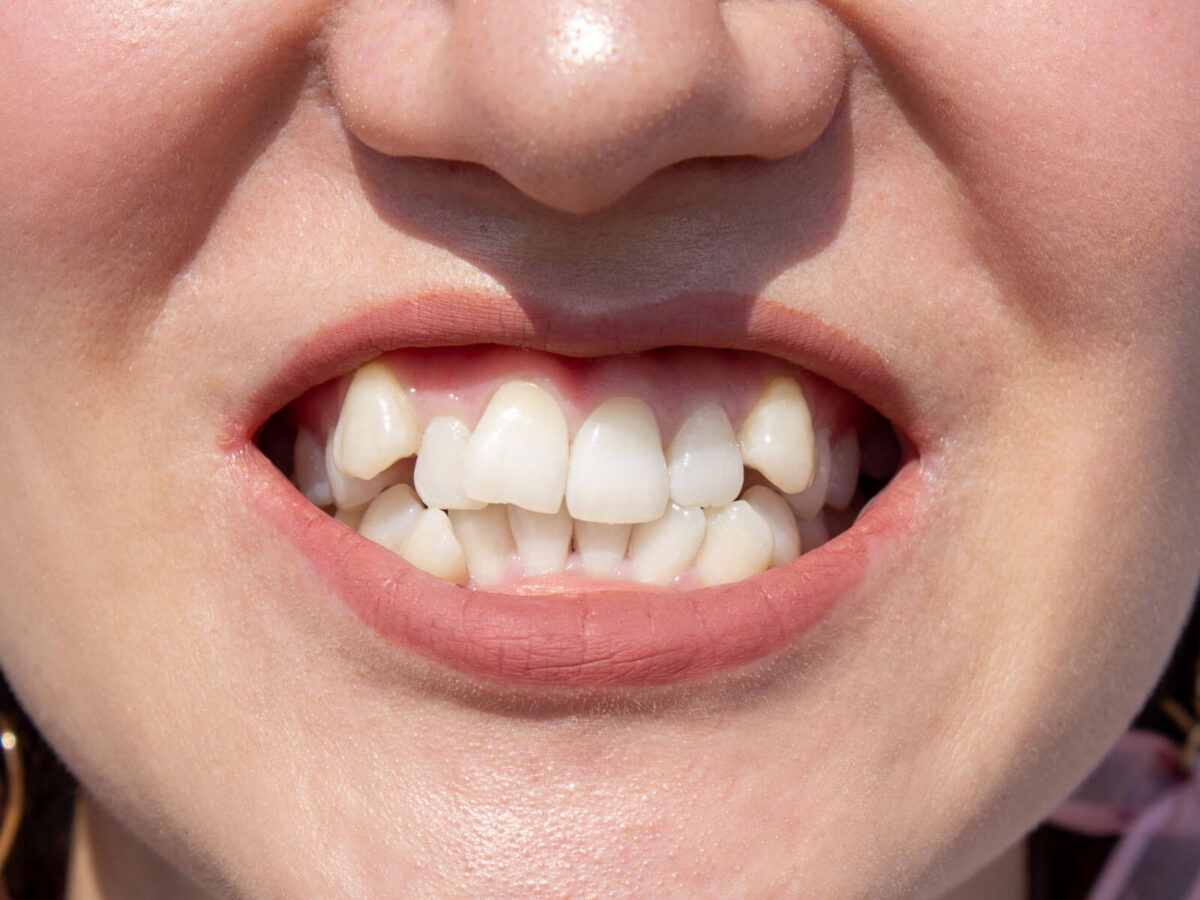
What Is Teeth Crowding? Definition, Causes & Treatment
Fourteen is when most people first notice it. A lower front tooth starts sitting slightly behind its neighbors, and suddenly every photo seems to catch it from the wrong angle.
That’s what crowding teeth really comes down to: your teeth need more room along the arch than your jaw actually has. Something has to give, so they overlap, rotate, or shove past each other to fit.
I see this constantly in practice, and it’s rarely a one-time problem. It’s the most common orthodontic complaint there is, and left alone, it tends to get worse rather than settle down.
TL;DR
- Crowding teeth is really just a mismatch, more teeth than your jaw has room for.
- Nearly half of adults deal with significant to severe crowding. It’s more the norm than the exception.
- Genetics drives most of it, though early loss of baby teeth and prolonged thumb sucking play a part too.
- Front teeth crowd first, and they don’t stop drifting once you’re an adult.
- Getting diagnosed just means a scan or impressions, measuring exactly how much space is missing.
- Mild cases respond to aligners, braces, or enamel reduction. Extractions handle moderate cases, and surgery’s reserved for jaws that are genuinely too small.
What Is Crowding Teeth, Exactly
Crowding teeth is when there isn’t enough space along your jaw for every tooth to sit flat, straight, and fully visible. The teeth themselves are usually normal size. It’s the arch that’s too short for all of them.
Think of your dental arch as having a fixed length, and every tooth taking up its own slice of that length, front teeth a little, back molars more. Add up all those slices, and you get one specific number in millimeters.
Once teeth run out of room, they find somewhere to go anyway. Some rotate, some tilt, some duck in behind a neighbor, whatever gets them to fit.
Dentists have a name for this shortfall: an arch length discrepancy. That’s what most cases of crowding teeth actually come down to, and it’s the exact figure they use to decide how mild or severe a case is.
How Do Orthodontists Grade It
Mild crowding is usually up to about 4mm of shortfall, and you’d likely only spot it in photos – a slight overlap between two front teeth, nothing that draws a second glance.
Moderate runs from roughly 4mm to 8mm. At this point, rotation and displacement are visible without a photo, a tooth sitting noticeably twisted or a canine crowding out its neighbor.
Severe means more than 8mm. Teeth can end up pushed entirely out of the arch, sometimes erupting high above the gumline where there’s simply no room left to land.
The number matters less to you than what it decides: mild often responds to aligners alone, moderate usually adds extractions or enamel reduction to the mix, and severe is where jaw surgery starts entering the conversation.
How Is Crowding Diagnosed
An orthodontist starts by taking impressions or a digital scan, building a model of your arch so every tooth’s position gets recorded accurately. From there, the actual measuring happens: how much space each tooth needs versus how much is really available.
X-rays check for teeth still under the gum too, since a tooth that hasn’t erupted yet can still be part of the crowding teeth equation, and missing it would throw off the whole picture.
Photographs and a bite check round things out, giving your orthodontist the full picture before recommending a treatment path.
What Are the Main Causes of Crowded Teeth
Genetics does most of the work. You can inherit your mother’s small jaw and your father’s large teeth, and that combination alone produces crowding.
Losing baby teeth too early lets neighboring teeth drift into the gap. By the time the permanent tooth underneath is ready to come through, there’s nowhere left for it to go.
Prolonged thumb sucking, extended pacifier use, and tongue thrusting all shift teeth over years through steady, gentle pressure.
Dental factors play a role too: extra teeth, unusually large teeth, or a narrow upper arch from mouth breathing during childhood, all common causes of crowding teeth.
How Common Is Crowding
Very common, common enough that dentists consider it the norm rather than the exception in most populations.
A paper citing the third National Health and Nutrition Examination Survey reports 45% of the adult population presenting with significant to severe dental irregularity, making crowding the single most prevalent malocclusion worldwide.
Other research lands in the same range, putting moderate to severe lower incisor crowding at up to 40% of the general population. However, if you look at the numbers, if your teeth overlap, you’re in good company, not an outlier.
Teeth Overlapping More Than They Used To?
Find out how much space you’re short and what would fix it.
Why Does Crowding Matter Beyond Appearance
Overlapping surfaces trap plaque where floss can’t reach. Decay and gum disease both tend to start in exactly those spots.
Uneven wear follows too. Crowded teeth meet the opposing arch at angles they were never really built for.
Severe cases go further still – chewing gets less efficient, and certain sounds get harder to form clearly.
What Signs Should You Watch For
Floss that shreds or won’t pass between two particular teeth is often the earliest practical clue. It usually means those two teeth are pressed too tightly together for anything, even floss, to slide through cleanly.
Bleeding that keeps coming back in one exact spot, no matter how well you brush, is usually your floss or brush telling you it physically can’t get in there.
There are visual signs too. A tooth sitting noticeably behind the line of its neighbors, a canine riding high above the arch like it never fully came down, or a lower front tooth that looks twisted compared to the ones next to it. Any of these on their own is worth mentioning at your next checkup.
How Is Mild Crowding Treated
Interproximal reduction is the least invasive option. Your orthodontist polishes a fraction of a millimeter of enamel from between teeth to create room.
Arch expansion works well in growing children, widening the upper jaw with a palatal expander before the mid-palatal suture fuses.
From there, braces or aligners take over, gently shifting teeth into whatever room those first two steps created. For mild cases, that combination is usually the whole treatment plan, nothing more needed.
Does Crowded Teeth Invisalign Work for Every Case
For mild to moderate crowding, aligners handle it well, and they’re now the default choice for a lot of adult cases.
Where they struggle is severe rotation, teeth needing significant vertical movement, and cases requiring large extraction spaces to be closed.
Compliance is the other limit. Aligners only work if they’re actually in your mouth for twenty-two hours a day, and treatment quietly stalls the moment they start living on a bedside table instead.
When Is Crowded Teeth Surgery Necessary
Only when the shortfall is skeletal, when the jawbone itself is too small or the wrong shape, not just the teeth sitting wrong on top of it.
Orthognathic surgery physically repositions the jaw, and braces run alongside it, both before the surgery and after. Start to finish, the whole process usually takes two to three years.
For adults whose palate has already fused, there’s a smaller option: surgically assisted expansion, which releases the bone so the upper jaw can still widen.
FAQ
Can crowded teeth straighten on their own?
No. Crowding tends to worsen slowly with age rather than resolve.
Is crowding just cosmetic?
Not entirely. It creates cleaning problems that lead to decay and gum disease over time.
Does everyone with crowding need extractions?
No. Mild and many moderate cases are treated with expansion, enamel reduction, or aligners alone.
Can adults fix crowding without braces?
Aligners work for many adult cases. Severe crowding still generally needs fixed appliances.
Conclusion
Crowding is a space problem, and every treatment is a different answer to the same question of where that space comes from. Widen the arch, slim the teeth, or remove one.
Which answer applies to you depends on how many millimeters you’re short and whether your jaw or your teeth are responsible for the mismatch. Only an assessment settles that, and it’s the fastest way to find out what’s actually behind your crowding teeth.
If flossing has become impossible in one particular spot, that’s usually the sign worth acting on, well before anyone mentions how it looks.
Find Out What’s Behind Your Crowding
Get measured properly and see which treatment options apply.

